
Table of Contents
What Does a Pap Smear Detect, and Why Is Testing So Important?
A Pap smear is a screening test designed to detect precancerous and cancerous cells on the cervix — the lower part of the uterus that opens into the vagina. During the procedure, a healthcare provider gently collects a small sample of cells from the cervix. This is usually collected with a brush or small spatula which is gently rotated in order to collect the sample. This sample is then sent to a lab and examined under a microscope for any abnormalities. The primary goal is to identify cervical dysplasia — abnormal changes in the cervical cells. These changes are often caused by the human papillomavirus (HPV), a common sexually transmitted infection. Up to 80% of sexually active adults will have encountered at least one strain of HPV. The body can usually clear the majority of HPV strains, however some strains can be more dangerous and are considered ‘high-risk’. If left untreated, these abnormal cells can sometimes develop into cervical cancer over several years. The importance of the Pap smear lies in its ability to catch these changes early, allowing for monitoring or treatment long before cancer develops.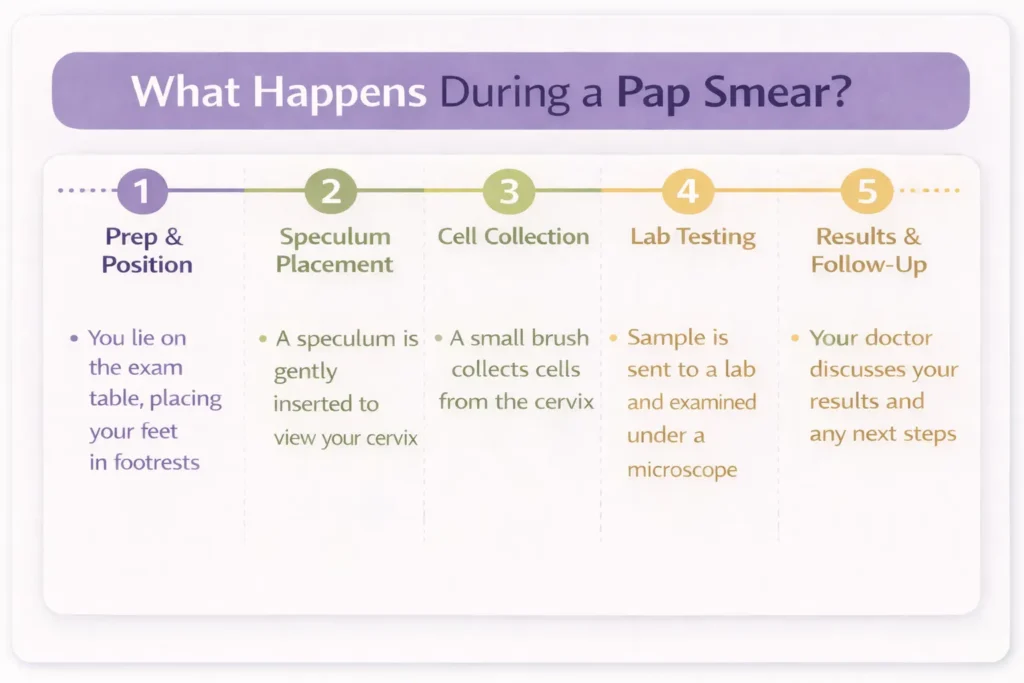
Pap Smear vs. HPV Test: Understanding the Differences
While often performed at the same time, a Pap smear and an HPV test are two distinct tests: Pap Smear: Looks for abnormal cell changes (cytology). It answers: “Are there any abnormal cells on the cervix right now?” HPV Test: Looks for the presence of high-risk strains of HPV. It answers: “Is the virus that can cause these cell changes present?” Since most cervical cancers are caused by HPV, screening has evolved. Today, healthcare providers often recommend one of three options: Pap Test Alone: A traditional approach, still effective. Primary HPV Test: Using the HPV test as the main screening tool. If positive for a high-risk strain, a Pap test may follow to check for cell changes. Co-testing: Performing both a Pap smear and an HPV test simultaneously. This is considered the most comprehensive approach for women aged 30 and over.How Long Does a Pap Smear Take?
A Pap smear usually takes about 5 minutes or less as part of a routine gynecological exam. The full appointment may take 20 minutes, but the actual cell collection portion of the Pap test is very quick. During the procedure:- You lie on an exam table and place your feet in footrests.
- A provider gently inserts a speculum to see the cervix.
- A small brush or spatula is used to collect a sample of cervical cells.
- The sample is sent to a lab where it is examined under a microscope for abnormal cells.
How Often Should You Get a Pap Smear Test? Age-Based Guidelines
General guidelines from organizations like the American College of Obstetricians and Gynecologists (ACOG) are as follows: Under 21: No screening is recommended. Ages 21–29: A Pap smear every 3 years. HPV testing is not typically recommended as a standalone test in this age group because HPV infections are very common and usually clear on their own. Ages 30–65: The preferred approach is co-testing (Pap smear + HPV test) every 5 years. Other acceptable options include a Pap smear alone every 3 years or a primary HPV test every 5 years. Over 65: You may be able to stop screening if you have a history of regular, normal test results. Discuss this with your doctor. Note: Blue Cross Blue Shield and other insurers typically require cytology testing alone every two years and HPV testing every four years. This differs from other national guidelines in the fact that you are being screened more often.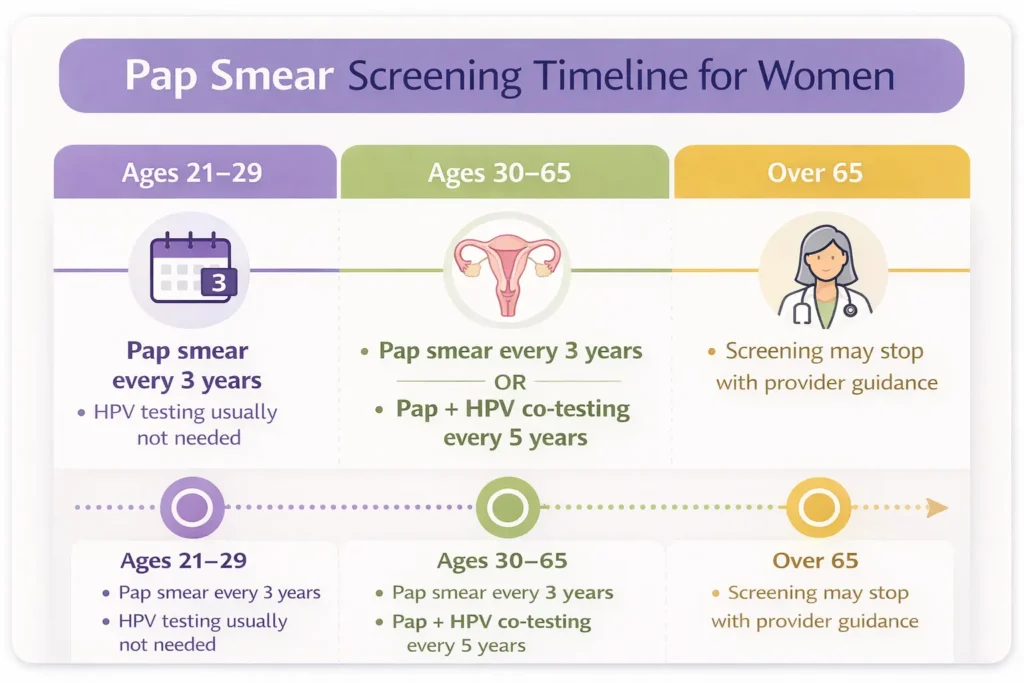 Important Note: These are guidelines for individuals with average risk. If you have a history of abnormal Pap smears, a weakened immune system, or other risk factors, your doctor may recommend a more frequent screening schedule.
Understanding Abnormal Pap Test Results
Hearing that your Pap test results are abnormal can feel stressful, but it is important to remember that abnormal results do not mean you have cancer. In most cases, the pap test simply finds small changes in the cells of your cervix. Many of these changes are mild and often go away on their own without treatment. Below are some of the most common types of abnormal pap test results and what they may mean.Mild Cell Changes: ASC-US and LSIL
ASC-US (Atypical Squamous Cells of Undetermined Significance) and LSIL (Low-Grade Squamous Intraepithelial Lesion) are the most common abnormal pap test findings. These results usually mean:- Mild changes were seen when the cells were examined under a microscope
- The changes can be linked to the human papillomavirus (HPV) but not always
- Inflammation, active vaginal infection, heavy menstrual bleeding can also be reasons for an ASC-US result
- The body frequently clears these changes naturally
- A repeat pap test
- An HPV test to look for high-risk strains of the virus
- Follow-up testing in about 1–3 years
- A colposcopy procedure if you have these mild changes and the HPV testing is also positive or you have these pap smear results two or more years in a row
80%
will encounter HPV
Quick Fact
Up to 80% of sexually active adults will encounter at least one strain of HPV in their lifetime. Most infections clear within 1–2 years — but persistent high-risk strains drive nearly all cervical cancers, which is why Pap smears remain essential even after HPV vaccination.
Source: CDC — HPV Fact Sheet; NCI — HPV and Cancer
Moderate to Higher-Grade Changes: HSIL and ASC-H
HSIL (High-Grade Squamous Intraepithelial Lesion) and ASC-H (Atypical Squamous Cells – Cannot Exclude HSIL) suggest more significant cell changes on your cervix. These findings do not mean cancer is present, but they can sometimes develop into cervical precancer if left untreated. Because of this, doctors usually recommend additional testing. Next steps may include:- Colposcopy, a closer examination of the cervix using a special magnifying device
- A small biopsy, where a tiny sample of tissue is taken for closer review under a microscope
Changes in Glandular Cells: AGC and AIS
Less common results include AGC (Atypical Glandular Cells) or AIS (Adenocarcinoma in Situ). These involve glandular cells rather than the surface cells of the cervix. Because these results can sometimes be linked to more serious changes, providers usually recommend prompt follow-up testing, which may include:- A colposcopy
- An HPV test
- A biopsy to examine the tissue more closely
- Ultrasound to evaluate the uterus and uterine lining
- Endometrial biopsy
Unsatisfactory Pap Test Results
Sometimes a pap test result comes back as unsatisfactory. This simply means the laboratory did not receive enough cells to evaluate properly. This can happen for several reasons, including:- Timing during the menstrual cycle
- Inflammation or irritation
- Too few cells collected during the exam
What Happens After an Abnormal Pap Test?
Depending on your results, your provider may recommend one or more follow-up steps:- HPV test – looks for types of HPV that can increase the risk of cervical cell changes
- Colposcopy – allows the doctor to closely examine your cervix using magnification
- Biopsy – small tissue samples are taken and reviewed under a microscope
- Treatment procedures – if cervical precancer is found, procedures such as LEEP can remove abnormal cells
- Monitoring – mild changes may only require repeat pap test screening and routine follow-up
| Age group | Recommended screening | Why |
|---|---|---|
| Under 21 | No Pap smear recommended | HPV infections in adolescents almost always clear naturally; screening causes unnecessary anxiety |
| 21 – 29 | Pap smear alone every 2 years | HPV co-testing not recommended as standalone — HPV is common and often self-clearing at this age |
| 30 – 65 | Pap + HPV co-test every 5 years or Pap alone every 2 years | Co-testing is preferred; persistent HPV is more clinically significant in this age group |
| Over 65 | May discontinue if criteria met | Requires 3 consecutive negative Pap tests or 2 negative co-tests in past 10 years; discuss with provider |
Note: BCBS and some insurers differ from ACOG — often covering cytology every 2 years and HPV testing every 4 years. Source: ACOG Practice Bulletin; USPSTF 2018.